


Blog
FAQ
PNMU0905 High-Feed Milling Insert – Lizhou Carbide Tools
time:
2026-01-29 13:38
source:
Lizhou


Why are there so many milling cutter blades?
Among the cutting tools, there are many different types of milling inserts because the materials being processed, the machining methods, and the machine tool conditions vary significantly. Consequently, different materials have varying requirements for edge sharpness and wear resistance. Moreover, the working conditions—such as face milling, shoulder milling, cavity milling, and curved-surface milling—also differ. Coupled with variations in machine tool rigidity and power levels, milling inserts come in a wide array of types, categorized by different shapes, angles, flute designs, and coatings. Only by selecting the right insert type can we ensure stable cutting performance, long tool life, and low costs. Today, let’s explore this together! Milling insert PNMU0905。
Milling insert PNMU0905 How is it different from other blades?
PNMU Milling blades, like other blades, are of the milling type.
The biggest difference is that the cutting methods are different. PNMU0905 By employing a small cutting edge angle and an arc-shaped cutting edge, the cutting force is more effectively converted into an axial force rather than a lateral impact.
Typically, milling inserts cut materials horizontally, resulting in relatively high vibration.
PNMU0905 It advances smoothly with the material, making cutting lighter and faster.
Therefore, it is particularly well-suited for high-feed, shallow-cut, deep-processing methods.
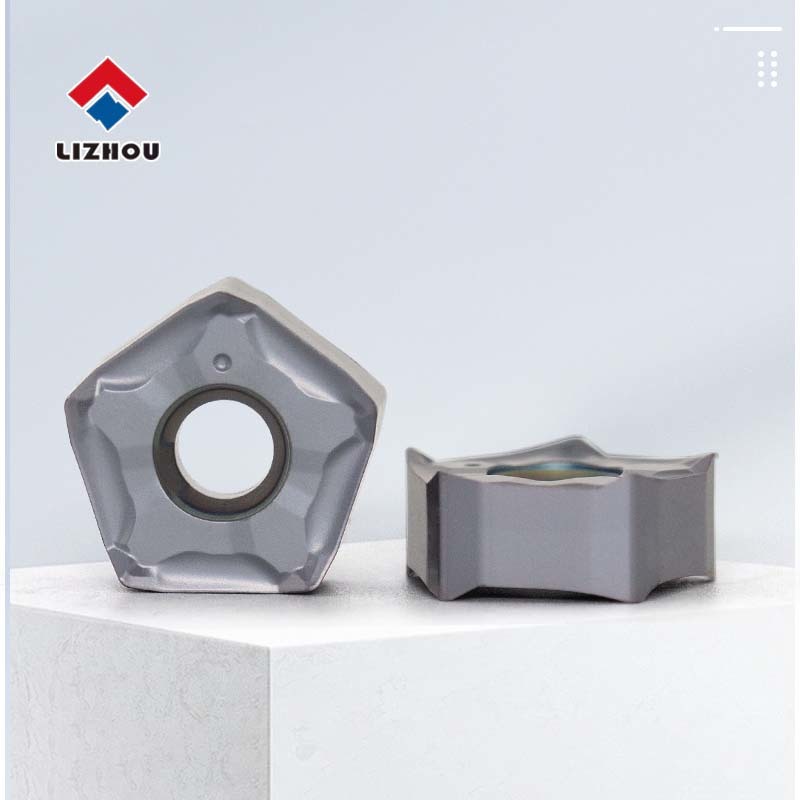
Milling insert PNMU0905 What materials is it suitable for processing?
This blade boasts exceptional versatility; commonly used materials include: carbon steel. / Alloy steel, die steel, cast iron, and certain types of stainless steel—but it demonstrates particularly stable performance in the roughing and semi-roughing operations for steel parts and die steels.
Lizhou PNMU0905 What operating conditions is it suitable for?
PNMU0905 It’s more geared toward efficient machining. Typical applications include high-feed roughing, cavity roughing, step roughing, and rapid material removal from flat surfaces. The machine tool generally has moderate rigidity. Its key feature isn’t deep cutting but rather extremely high feed rates—resulting in a high material removal rate per unit of time—which is precisely why many people prefer it. PNMU One of the reasons for the milling cutter.
PNMU0905 Common FAQ
Q1:PNMU0905 Is it for rough machining or finish machining?
A Primarily used for roughing and semi-roughing operations, especially for high-feed, rapid material removal—this is not a blade intended for finishing.
Q2: PNMU Is there a high requirement for machine tool rigidity?
A Not high—its high-feed design converts cutting forces into axial forces, allowing even machining centers with moderate rigidity to operate stably.
Q3:PNMU0905 How deep can you eat?
A The cutting depth is relatively shallow; typically, a shallow cutting depth is combined with a large feed rate to improve efficiency by increasing the cutting speed.
Q4:PNMU0905 Is it suitable for machining stainless steel?
A Yes, but choose a non-stick coating and carefully control the parameters. It’s especially recommended for steel parts and die steels.
Q5:PNMU0905 Is it prone to chipping?
A It’s not easy—its arc-edged design offers excellent impact resistance and is more stable than conventional milling blades.
Q6:PNMU0905 and APMT What’s the difference?
A : APMT It's universal milling. PNMU0905 It’s specifically designed for high-feed machining, offering higher efficiency and a different cutting method.
Q7 Is it suitable for cavity machining?
A :Perfectly suited, especially for scenarios such as roughing cavity molds.
Q8:PNMU0905 What is the minimum order quantity?
A The minimum order quantity is 100 The piece can be customized according to the sample.
In short, PNMU0905 This milling insert boasts high feed rates, high efficiency, and low vibration as its core advantages. It is particularly well-suited for rapid material removal in the machining of steel parts and die steels, making it an invaluable tool for many machining centers when performing roughing operations and initial roughing cuts.
Recommended products


Hotline:
IPV4 / IPV6