


Blog
FAQ
Lizhou 55° 4-flute flat-end milling cutter for machining high-hardness materials
time:
2025-11-28 14:55
source:
Lizhou


In the metal cutting industry, materials with high hardness—such as die steel, alloy steel, and martensitic stainless steel—are often the most challenging to machine. These metals generate higher heat and greater cutting resistance during the machining process, placing even higher demands on tool wear resistance, edge strength, and stability.
Improper tool selection can not only affect efficiency but also potentially lead to issues such as chipping, surface roughening, and dimensional inaccuracies in machining.
To meet these operational requirements, Lizhou Tools has launched... 55 degree 4 Flat-end milling cutter This tool features a self-developed matrix material with high hardness and toughness as its core. Through rigorous process control, it achieves a more balanced level of wear resistance, sharpness, and stability, making it an ideal choice for mold manufacturers, parts processing plants, and mass production environments.
I. Specifically for HRC55 Made from the following materials, it is more suitable for machining high-hardness metals.
Many traditional knives are used in machining. HRC50 When machining the above metals, issues such as chipping at the cutting edge, high cutting resistance, and excessive heat generation are prone to occur. This product from Lizhou... 55 The end mill utilizes a self-developed ultra-fine-grain, high-toughness cemented carbide substrate, enabling the tool to maintain stable performance even when machining materials of high hardness.
Applicable to ≤ HRC55 Carbon steel, alloy steel, and die steel
Capable of stable machining of gray cast iron and ductile iron.
It also exhibits good machinability on martensitic stainless steels.
Greater substrate toughness makes the tool less prone to chipping during high-speed cutting; higher hardness gives the tool superior wear resistance.
This makes machining high-hardness steels no longer difficult, significantly reducing tool wear and the frequency of tool changes.
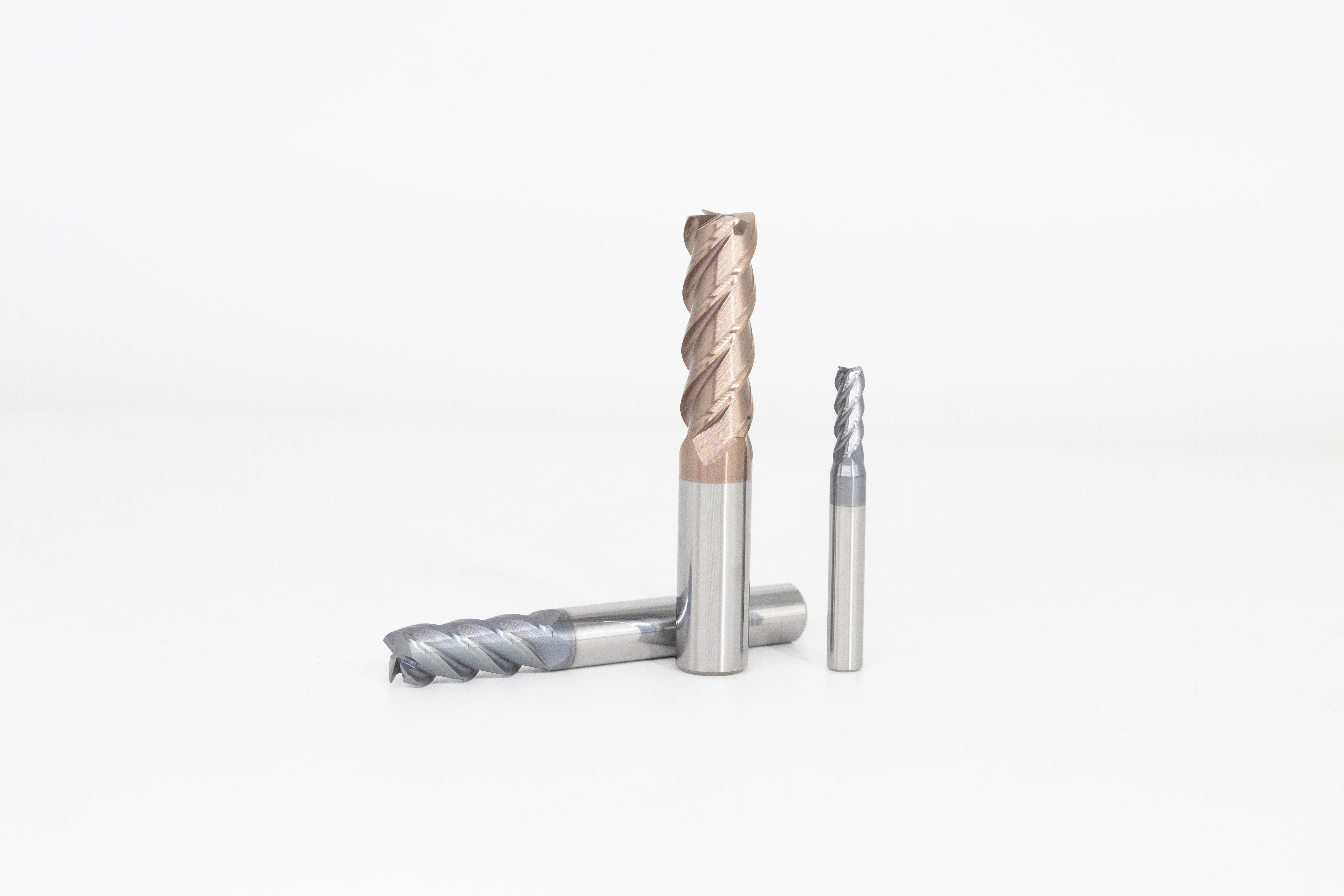
2. The four-blade cutter head enhances efficiency and stability, resulting in a smoother machined surface.
The four-flute configuration is one of the most commonly used cutter types in high-efficiency machining. Compared to two-flute or three-flute tools, a four-flute cutter head features:
Higher unit cutting volume
The tool has better overall rigidity.
Cutting is smoother.
The surface roughness is more uniform.
Especially when machining hard materials such as mold steels and alloy steels, tool rigidity is crucial for stable machining. The four-flute design effectively reduces vibration, improves dimensional consistency during machining, and results in smoother, more refined part surfaces.
For processing plants that strive to balance efficiency and precision, this structural design is particularly practical.
Three, You Chip-removal groove + Double-edged belt structure for smooth cutting and no chip buildup.
Cutting high-hardness materials inherently involves significant resistance. If chips are not removed promptly, it can easily lead to overheating of the cutting tool and even cause chipping or blade failure.
This model 55 Use a milling cutter with a degree of tilt. You Chip-groove design: provides greater chip evacuation space, ensures smoother cutting, reduces secondary wear on the tool caused by chip accumulation, lowers heat generation, and enhances machining stability.
Meanwhile, the tool design incorporates a double-edged band structure, further enhancing the tool’s guiding performance and ensuring that it remains stable during machining—preventing unwanted vibrations and minimizing the risk of “tool collisions,” thus maintaining consistent precision.
This combined design can significantly improve tool life and reduce machining costs in actual processing.

4. Standard flat-blade design, suitable for common machining scenarios.
The flat-end milling cutter is one of the most widely used cutting tools in machining, suitable for processing a variety of common structures:
Side machining: Maintaining straightness and flatness
Step machining: The tool has sufficient strength and is resistant to chipping.
Right-angle groove machining: The bottom surface is flat and the geometric shape is accurate.
Roughing and Semi-Finishing for General Cavity Molds
For applications such as machining mold cavities, contours of mechanical parts, keyways, and similar operations, this flat-end cutter can cover nearly all machining needs and is a commonly stocked, versatile tool in workshops.
5. From materials to cutting tools, Lizhou maintains strict control throughout the entire process to ensure stability and efficiency.
Lizhou Tools has consistently adhered to the manufacturing philosophy of “controllable throughout the entire process,” with every step—from substrate selection to finished product shipment—undergoing rigorous management.
1. Self-developed high-toughness ultrafine-grained material
Improve the tool's resistance to chipping and extend its service life.
2. Five-axis simultaneous grinding process
Ensure consistency of cutting edges, symmetry of flute geometry, and precision of geometric angles.
3. Optimal Design of Tool Structure
Improve cutting smoothness and reduce machining resistance.
4. The coating is uniformly applied and has high heat resistance.
Keep the cutting tool in better cutting sharpness and stability.
5. Full inspection process before leaving the factory
All parameters—outer diameter, runout, and cutting edge condition—are thoroughly tested to ensure that the product is ready for immediate machining upon delivery to the customer.
This manufacturing standard ensures that the cutting tools maintain excellent stability when machining high-hardness materials, thereby reducing quality issues such as "tool breakage during machining" and "dimensional deviations."

6. We offer a complete range of specifications and support custom-made solutions, better meeting actual production needs.
Lizhou Tools offers a complete range of specifications, including various combinations of parameters such as different diameters, blade lengths, shank lengths, and helix angles, making it easy for customers to select products according to their needs.
Also supports: custom special blade shapes, long blades specifically designed for deep grooves, extended-shaft models, and special diameters. R Angles, custom groove types, OEM/ODM Bulk customization
Whether you’re in the mold-making industry, a parts-processing plant, or operating a production line with complex process requirements, we can provide you with tooling solutions that are more closely aligned with your actual machining scenarios.
7. From the Customer’s Perspective—Why Choose Lizhou? 55 degree 4 Flat-end face milling cutter?
Tool life is stable, and it’s not easy to chip even when machining high-hardness materials.
Smooth cutting, excellent chip removal, and higher machining efficiency.
Good surface finish, reducing polishing and secondary machining.
Highly versatile—one blade fits multiple scenarios.
Complete specifications and customizable options, saving on tooling and spare blade inventory.
High cost performance, saving costs with long-term use.
For factories that prioritize processing stability and efficiency, this model from Lizhou... 55 Indexable milling cutters can significantly reduce “uncertainty” in production, truly making tools effective instruments for boosting productivity.
Recommended products


Hotline:
IPV4 / IPV6