


Blog
FAQ
The difference between a flat end mill and a ball end mill
time:
2025-05-21 17:02
source:
Lizhou


Flat end mills and ball end mills are two commonly used milling tools. Flat end mills, also known as square end mills, differ mainly in their structure, machining objects, and applications.
|
Structural Design
|
Main Applications
|
Cutting Characteristics
|
Flat End Mill
|
The cutter head has a flat bottom (right-angle end face), with cutting edges on both the side and end faces.
|
Plane Machining : Such as milling planes, steps, and right-angle contours.
|
Evenly distributed cutting force, suitable for high feed rates and large depths of cut.
|
Ball End Mill
|
The cutter head is hemispherical (arc-shaped), with cutting edges distributed along the spherical surface.
|
Transitional Fillet Machining : Arcuate transitions at the corners of the workpiece.
Finishing : Obtaining a smooth curved surface through continuous cutting.
|
The cutting force is concentrated at the tip of the ball head, easily causing vibration and wear.
|
Which is better, a flat end mill or a ball end mill?
There is no absolute " better or worse ” between flat end mills and ball end mills. The key depends on the specific processing needs, workpiece shape, and processing goals. 。
Flat end mills are more suitable for rough machining, while ball end mills are mainly used for finishing.
II. Performance Comparison
Characteristics
|
Flat End Mill
|
Ball End Mill
|
|---|---|---|
Machining Efficiency
|
High (Suitable for rough machining)
|
Low (Mainly for finishing)
|
Surface Quality
|
High plane quality, stepped tool marks on curved surfaces
|
Smooth curved surface, easy wear in the center of the plane
|
Tool Life
|
Longer (Uniform cutting force)
|
Shorter (Tip is easily worn)
|
Programming Complexity
|
Simple ( 2.5 axis path)
|
Complex (requires 3D path planning)
|
Applicable Materials
|
Hard materials, high-rigidity workpieces
|
Soft materials or complex curved surface workpieces
|
III. Typical Application Scenarios and Selection Suggestions
1. Flat end mill: The " main force ”
for efficient material removal.
Recommended scenarios:
Plane milling (such as processing bases, panels); T grooves);
Sidewall finishing (requires a high-rigidity clamping system);
Step machining and rough milling of contours.
Selection tips:
Rough machining: Choose a multi-blade design (such as 4 blade) to improve chip removal capacity;
Finishing: Use coated cutters (such as TiAlN ) to reduce friction;
Deep groove machining: Prioritize long-neck type ( Reach End Mill ) to prevent vibration.
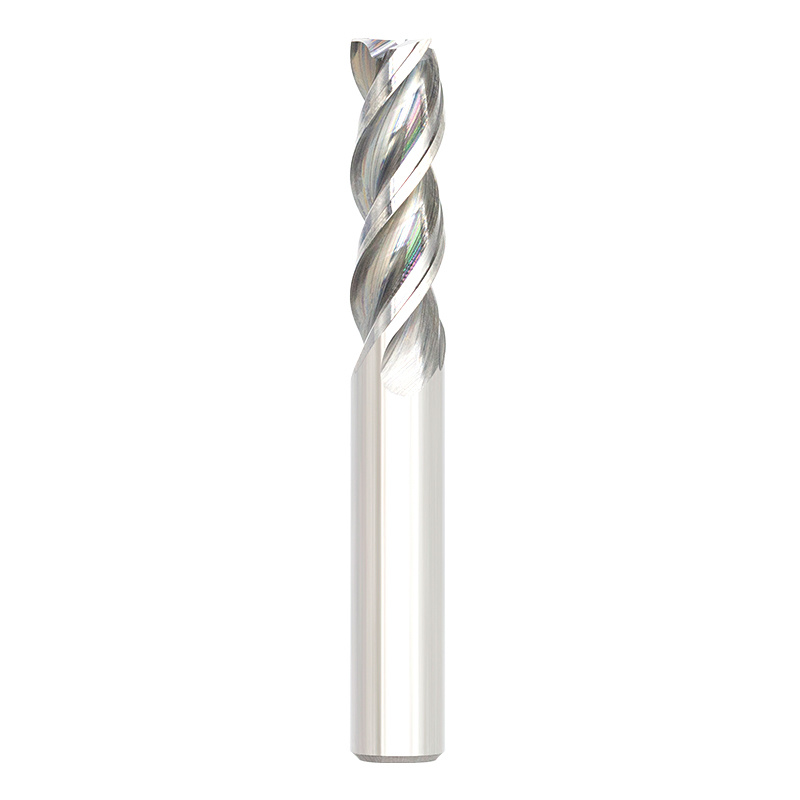

1. Flat end mill: The " main force ”
for efficient material removal.
Recommended scenarios:
Plane milling (such as processing bases, panels); T grooves);
Sidewall finishing (requires a high-rigidity clamping system);
Step machining and rough milling of contours.
Selection tips:
Rough machining: Choose a multi-blade design (such as 4 blade) to improve chip removal capacity;
Finishing: Use coated cutters (such as TiAlN ) to reduce friction;
Deep groove machining: Prioritize long-neck type ( Reach End Mill ) to prevent vibration.
Summary of Selection Suggestions
Choose a flat end mill : For efficiency, machining planes or right-angle features.
Choose a ball end mill : For machining complex curved surfaces, fillets, or high-precision surfaces.
Recommended products

undefined
Hotline:
IPV4 / IPV6